Heathfield Commercial Capital sends the request on to funding partners; whether to offer, and on what terms, is their call.
Equipment financing spreads the price of a machine over the years it will work, with the machine as collateral. A loan or finance agreement puts it in the business's name from the start; a lease is rent with an end date and a choice at the end. The calculator on this page works out a payment from price, down payment, rate and term.
At a glance
- What it pays for
Loaders, trailers, mowers, laundry machines, coolers, room appliances
- What backs it
The equipment being bought
- Forms it takes
Loan, equipment finance agreement, $1 buyout lease, fair market value lease
How Does Equipment Financing Work for a Teton County, WY Lodge's Laundry Room?
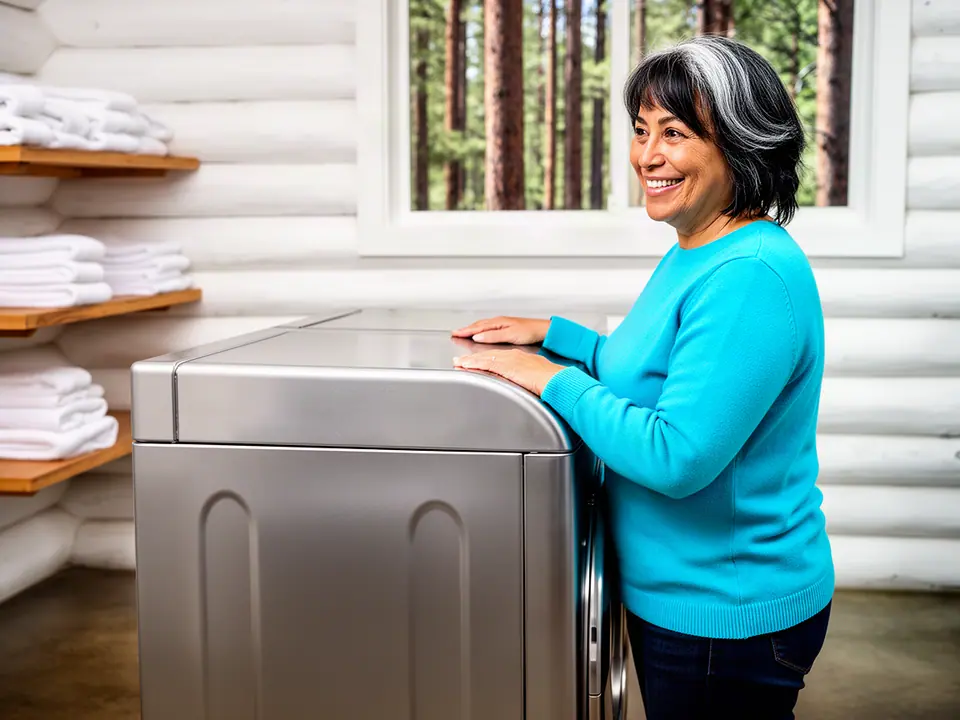
A lodge laundry room runs on a few heavy machines: washer-extractors, large dryers, a folding table and carts. When one fails, the owner can pay cash for the replacement package or spread its price over the years the machines will run. Equipment financing is the second path. The seller's quote sets the amount, the machines secure it, and the payments are fixed for the term.
Illustration only, invented figures: the laundry package is quoted at $26,950. With $2,950 paid up front, the lodge finances the remaining $24,000 for five years (60 months) at 9.6% a year. The payment is $505.22 a month; sixty of them total $30,313.20, so interest comes to $6,313.20, and the full cost with the down payment is $33,263.20. The calculator on this page takes the same four inputs, price, down payment, rate and term, so the owner can try a larger down payment or a shorter term.
Plumbing hookups, drains and venting for the machines are building work and sit outside this site; the request covers the machines themselves.
Is Equipment Financing Debt? What a Stand-On Spreader Purchase Leaves the Business Owing
Yes, in the plain sense. A loan or an equipment finance agreement leaves the business owing the funding partner until the last payment, and the partner holds a claim on the machine until then. A lease is different on paper: the business pays rent for the use of the machine and owes the remaining rent, not a principal balance.
Take a landscaping company buying a stand-on spreader for fertilizer and seed. Financed, the spreader is an asset the company owns with an obligation beside it that falls with every payment. How a loan or a lease appears in the company's accounts, and what that means at tax time, is a question for its accountant, not for this site.
Debt is not a bad word here. A machine that earns more each month than its payment can carry its own financing; one that sits idle cannot.
How Do Equipment Leases Work? Monthly Rent, an End Date and Three Ways Out
An equipment lease lets a business use a machine for a fixed number of months in return for a monthly payment. Through the whole lease, and after it unless the business buys it, the machine belongs to the leasing company. When the term ends, the agreement gives the business three ways out, and the right one depends on how long the machine is still useful.
- Hand the machine back and walk away, after any return conditions in the agreement are met.
- Buy it at the price the agreement sets: a fixed amount such as $1, or its fair market value at the time.
- Renew or extend the lease, if the agreement allows it.
A lease can make sense for an aerator or a piece of kitchen gear the business expects to replace in a few years. A machine the business plans to keep for a decade may cost less over its life when it is owned; the way to find out is to price both paths with real quotes.
Used Heavy Equipment Financing: Pricing a Second-Hand Compact Track Loader in Jackson, WY
A partner may offer a shorter term on a second-hand machine, matched to the fewer working years it has left. That raises the monthly payment even when the price is lower, so on a used quote the term matters as much as the price.
Illustration only, invented figures: a Jackson, WY landscaping company finds a second-hand compact track loader for $38,600. Priced at 11.35% a year for 36 months, the schedule asks $1,270.12 monthly; by the final installment the company has paid $45,724.32, $7,124.32 of it interest. Spread over 60 months at the same invented rate, the payment would fall to $846.01, $424.11 less each month, but interest would climb to $12,160.60, adding $5,036.28, and the loader would carry a payment two years further into its working life.
Construction businesses with paid staff numbered 323 in Teton County, WY in 2023 (County Business Patterns), with 2,434 employees between them. Those trades can run loaders, trailers and attachments, and each request is reviewed on its own machine and its own records.
Rate Named or Payment Only: Reading an Equipment Finance Agreement Next to a Loan in Teton County, WY
Two offers for the same skid steer can arrive on different forms: one names a principal and a rate, the other only a payment and a count of payments. Either way the business has the machine from day one, the machine is the collateral, and nothing is owed after the last payment.
- A loan agreement states a principal and an interest rate; the payment follows from those two numbers and the term.
- A finance agreement may state only the payment and the number of payments, without naming a rate.
- A partner may use one form for some machines and the other form for the rest.
- Either way, the owner can ask for the annual rate and the total of all payments before signing.
For a Teton County, WY business comparing two offers, the second list item is the one to watch: a finance agreement that names only a payment has to be turned into a rate by hand before it can be compared with a loan. The next section shows how that works with a lease quote.
How Does a $1 Buyout Lease Work? Turning a Skid Steer Quote Into an Annual Rate
Call it a lease if you like, but a $1 buyout agreement ends with the business owning the machine for a single dollar. The business pays a fixed monthly amount for the term, then makes that one-dollar purchase. Because ownership at the end is certain, the honest comparison is with a loan, and the way to compare is to find the annual rate hidden in the lease payment.
Illustration only, invented figures: a skid steer is priced at $54,300. The lease quote asks $1,392 a month for 48 months, plus the $1 buyout, for a total of $66,817. Solving for the rate that turns those payments back into the $54,300 price gives about 10.57% a year (our arithmetic). A 48-month loan at exactly 10.57% would ask $1,392.10 a month, ten cents more than the lease, because the lease rate rounds to the same figure.
In this example the two paths end up $3.80 apart over four years, which is rounding. In a real quote they may not: some leases add document fees, insurance requirements or an advance payment, and each of those changes the rate. Run each quote through the same arithmetic, or ask the partner for the rate, before choosing. Machine requests can begin on the apply page too. An $8,450 hardscape saw on a 36-month schedule is priced on the Jackson, WY page. Short notes on salon chairs, dental scanners and day care vans are grouped by trade on the industries page. Equipment financing appears in five posts: room appliances for a lodge, landscaping machines ranked by days of use, an ultrasound unit and ECG cart, a copier and a mini excavator leased or owned and a sign shop asset sheet.
By Heathfield Commercial Capital · Updated